
.png)
"Son Dos Alas"
Anónimo Consejo featuring Tego Calderón
Participating Alfredo 'Punta de Lanza' Hernandez, Viviana Pintado & DJ Racier
Musical composition by Echo a.k.a. Paul Irrizary
Directed and produced by M.Rivière
M.Riviere Anthropologist & Producer |
"Son Dos Alas"Anónimo Consejo feat. Tego Calderón |
"Guasábara"SieteNueve feat. Magia |
"Sin Permiso"Los Aldeanos feat. Intifada |
"Sangre Guerrera" El Bi & SieteNueve |
El Triangulo EstudioLa Conección Real |
Doble Filo Cuba Yrak & EdgarO // "Despierta" |
B-GIRL BEA Celebration of Women in Hip-Hop |
Ritmos UnidosAnnual Afro-Latin Tribute to MLK Day |
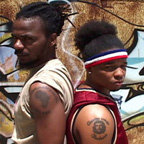

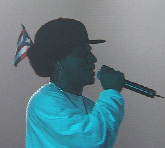
left: ANC in Alamar (2004) // right: Tego at United Palace, NYC (2003)
Photographs by M.Riviere
"Son Dos Alas"
Anónimo Consejo featuring Tego Calderón
Participating Alfredo 'Punta de Lanza" Hernandez, Viviana Pintado & DJ Racier
Musical composition by Echo a.k.a. Paul Irrizary
Directed and produced by M.Rivière
The Brotherhood of Race
The song "Son Dos Alas” by Anónimo Consejo featuring Tego Calderón marks history as the first musical collaboration in the genre of hip-hop between Cuba and Puerto Rico recorded on site in each location. The artist’s objective was to highlight race as transcendental to political boundaries between their two islands. Afro-Cubanismo offers a mixed racial identity. Miscegenation is still seen as a whitening process and underlying themes of an egalitarian society have taken their toll on the lack of images, politics and recognition of race dynamics in popular media outlets in both Cuba and Puerto Rico. Both Tego Calderón and Anónimo Consejo are considered mainstream rappers in their respective island where they regularly engage with major media outlets but do not regularly see their phenotype proportionately publicized.
In reference to Cuba, the Revolution is said to have encompassed issues of racial inequality, however racism remains a common theme of Cuban rap. Due to the U.S. embargo imposed on the nation, today Cuba relies primarily on economic development via remittances and tourism. Ironically those who have family members in the US from whom Cubans receive remittances tend to be the lighter skinned population who fled the island during the inception of the Revolution. This racial dichotomy is also true of those individuals hired to work in the tourism industry, primarily the Cuban ‘mulattos.’ This access, or lack there of, to economic opportunities created new class identities defined by race and occupational outlets in an ideally classless society.
In contrast Puerto Rico has hybridized racially as much if not more than Cuban society. It was in fact considered one of the ‘whitest’ islands of the colonial Caribbean as a layover between Spain and the Americas. Today the racial mix between Taino Native Americans, Africans and Europeans permeates Puerto Rican society. Influenced by the political nature of Puerto Rico’s commonwealth status, issues of race tend to get overlooked by concerns for nationalism.
Tego Calderón redefined the sound and look of Latin hip-hop and reggaetón with the production of his debut album ‘El Abayarde’ in 2002 (White Lion Records), yielding an unprecedented Afro-Latin listening base and reifying issues that pertain to the contemporary Caribbean new Afro-Latin identity of the Americas. In general the term ‘Afro’ declaring race has been uniquely hyphenated with nationhood, such as Afro-American, Afro-Cuban or Afro-Brazilian. In Spanish such a hyphenated term simply doesn't exist. In Latin American most classifications are based as much on class as they are on race. For example, education or economic success can often times wash out racial classifications. For years Afro-Dominicans have been lobbying state authorities for the right to be categorized as "Black'' on their passports. In contrast, Afro-Latin scholars debate as to whether Afro-Argentineans even exists, and if they do whether they are an endangered group - yet in neighboring Brazil over half of the population identifies itself as pertaining to African ancestry.
During colonial times only 5% of slaves brought from Africa ended up in North America. Thus, the vast majority of African descendants were transported to Latin America. When we look at Latin America, the Afro-Latin identity is far more complex than in the US. Take for example the Mexican Government's 2005 release of a series of stamps featuring Memin Pinguin, a Jim-crow era sambo figure popularized in 1940’s Mexican comic books. Activists, both domestic and international, have criticized the government’s use of the figure citing it as offensive on a global level. While Mexico’s official response has been a denial of the racist nature of the figure. Mexican officials argue that critics don’t understand Mexican culture and that all Mexicans adore the figure.
While this controversy raises several important issues about race, one that stands out is the dichotomization of Afro and Mexican that occurred in the midst of these debates. The fact that people don’t know that black Mexicans exist, doesn’t change the fact that they do, and in fact a small number have begun to organize under the name 'Mexico Negro.' The ‘leaving out’ of black Mexico in this debate, points to a larger failure to incorporate the experience of Afro-Latinos into academic and activist dialogues about race and racism. Voicing the hyphen, as we see in Tego Calderón's and Anónimo Consejo's linguistic and imaginary performances, means precisely placing a spotlight on this 'no-longer-invisible" identity so that through music and arts we can celebrate its existence. From a marketing perspective, the concept of Afro-Latinism as a purchasable identity marker is exploited amongst these groups since they are seen as a potential new consumer group.
Race and ethnicity are integral factors in measuring the social exclusion and poverty faced by Afro-descendants in Latin America. There is a strong correlation between race, ethnicity and access to social services such as education and health care (hygiene and access to clean water/environments), as well as sustainable development initiatives and the empowerment of role models. Latin American nations never experienced a civil rights movement equivalent to that led by Martin Luther King, Malcolm X, and other activists of their era. As a result many nations have suffered prolonged racial tensions made more complicated by imbedded working class struggles.
Perception and solidarity of ‘Blackness’ is an issue of great importance in the diffusion of hip-hop into both islands. The racial aesthetics of rap offer youths an alternative source of Afro-pride and empowerment than that available through the national avenues designated for celebrating Afro-Cuban or Afro-Boricua identity. Figures such as Malcolm X, Chaka Zulu, Mumia Abu Jamal, and Assata Shakur are predominant protagonists of Tego Calderón’s and Anónimo Consejo’s repertoires and music videos. This work attempts to bring to the forefront the relative themes each island’s artists are concerned with today with respect to racially defined identities and their relationship to the nation-state that more often than not works towards excluding such groups from full participation or discursively erases their presence in the social fabric. Son Dos Alas counter acts this making a clear statement – we are no longer invisible, we are here. And even if you don’t like it – you must include us because we are no longer slaves.
Since enslavement, Afro-diasporic communities have formed ‘safe’ or ‘protected’ spaces in social gathering areas. Such spaces allow for a social control that can act as witnesses of abuse or repression. These spaces act as refuge towards hostile everyday realities of racialized forms of marginalization. Within these collective spaces cultural forms prevail. We see the development of music, dance, song and oral narratives enabling an experience of in-depth social meaning. In this participatory ethnographic production of Son Dos Alas, the song itself becomes a safety zone, in which the repression from the state or the market seems irrelevant due to the far-reaching access and audiences of the musical track. The more public the song, the more social vigilance can act as a witness, and therefore the space in the media and through the music is perceived by artists as a safe gathering space.
Tego became known as a ‘phenomenon’ by his capacity to add social, political and racial dimensions to the message of his music while keeping the melody entertaining. He was the first hip-hop / reggaetón artist to sign to a major label (Billboard 2005) and is recognized as a pioneer for taking reggaetón to its current global dimensions. His incorporation to the proect brought with it the attention from his fans and media allies which guaranteed Anónimo Consejo a new secured listening audience based on Tego’s draw and an elevation in their public perception within Cuba to have gained access to record with such a major artist as is Tego. The fact that this project was completed independently, without the reliance of an Agency or any institution eased the tension that any sponsor or state institution might censor or manipulate the content.
Anonimo Consejo is made up of Sekou Mesiah and Kokino. The due was founded in 1996. They are well-known rappers from the town east of Havana called Cojimar. They are known for their distinct Black pride repertoire combining rap and reggae vocal styles. The rap duo forms part of the Cuban Agency for Rap catalogue since the agency was started in 2002. They have been participants of the Habana Hip-Hop festivals (1995 – 2004) and later the Cuban Hip-Hop Symposiums (2005 – 2008). Although their lyrics entail protest themes, these are usually metaphorically presented so as imply critiques rather than directly pointing them out which could come off as abrasive. Anonimo Consejo have mastered the fine line of pushing lyrical content while maintaining a mainstream repertoire. They have had the opportunity to perform on stages abroad and even sold out the Apollo Theatre in Harlem, NYC in 2001.
Getting it Done
I produced “Son Dos Alas” between December 2004 and January 2006. This included recording separate portions of the song in both Havana and San Juan. Initially I approached Tego with five tracks by Anónimo Consejo to familiarize him with their style and lyrical repertoire. Once Tego confirmed his interest in the project, producer Paul Irrizary, a.k.a “Echo’ donated the beat co-produced between his assistant “Diesel” and himself. I took the background beat to Cuba in January of 2005 where I rented out a space in the Electro-Acústica Studios and recorded the introductory columbia rumba rhythm and vocals by Alfredo ‘Punta de Lanza’ Hernández along with Anónimo Consejo’s vocals, and the scratches by DJ Racier. I initially mixed a draft of these recordings, labeled the song temporarily ‘Cuba y Puerto Rico Son” and sent the reference to Tego in Puerto Rico. Tego immediately approved the song for his inclusion and independently recorded his verse with musical producer and engineer Hyde and returned the a capella vocal files to me with a new musical reference. However he did not like the chorus, as I also had my reservations. I took a tail end of improvisational lyrics by Sekou who sang "Y si yo sigo tu sigues, y si yo vivo tu vives" and played with them until I was able to cotoure them into a chorus.
Tego expressed his interest in publishing the song and at first considered putting the song in his upcoming “The Underdog” album which he announced in Primera Hora (Univision) in March of 2005. However we both agreed we wanted to make changes to the final version, a new mix and the incorporation of the new chorus that I had reconstructed from scraps of Sekou’s vocals. The public announcement that Tego had recorded with Anónimo Consejo proved to offer controversy amongst the Cuban exile community of Miami. Tego;s reaction was stand offish to the song, and he lost contact putting off signing the contractual consent/release form to participate in this project. It seems that the song would never blossom and Tego’s loss of enthusiasm to release the song became a marketing concern to ward off menaces of boycotts to his upcoming album.
At this time, I expected “Son Dos Alas” to be the only song of the participatory ethnographic production in my doctoral research. Therefore this awkward situation carried even greater weight on my cautions as ethnographer. If Tego decided to not accept the consent / release form, there would be no song. I continued to develop the mix and the structure of the song, but began setting my sights on a potential new track or even a new project considering the dilemma of Tego’s unsigned release form. Portions of the song were cut to restructure a new chorus using vocals from Cuban singer and composer Viviana Pintado who composed and recorded a new vocal harmony for the chorus to offer a layered series of vocals singing 'Son Dos Alas' and 'Cuba, Puerto Rico' which resulted in my naming the song "Son Dos Alas.\"
Tego received a copy of the completed track, and on a personal level was positive about the project and the track, however he continued to ignore signing of the release for years. Mind you, he used the intro by Alfredo “Punta de Lanza’ Hernandez which I produced as the intro to “Son Dos Alas,” in his own Atlantic Records 2006 release of “The Underdog/El Subestimado” but it had no reference to its origin, no signed contract, and was presented as an isolated interlude. The credits on the CD never referenced the artists, nor myself as the producer, and even less, Cuba as the location where the track was recorded. It did however keep the original name of the track of for this project, Son Dos Alas, giving the rights over to Atlantic with out owning them in full. All of the sudden I had to accept that my first musical production and my doctoral reseach project that took three years of hard work was presented as if created in a vacuum and limited from mainstream worldwide circulation.
In April of 2006 I requested a live public broadcast premier of “Son Dos Alas” on the Puerto Rican radio show Hip-Hop Vox, a University of Puerto Rico program dedicated to hip-hop that is a branch project of Phantom Vox (belonging to the pop artist Robi Draco Rosa). I invited Tego to come on the air assuming such an initiative would help push his contractual as well as creative relationship to the song. The broadcast was historical, Anónimo Consejo were live on the phone and on the air throughout Puerto Rico and via internet around the world. It was the first time Puerto Rico had a live broadcast from Cuban emcees. Only one thing was missing, Tego never showed up.
Back in Havana, Anónimo Consejo had leaked the old version of the song with the previous chorus. The song was circulating throughout the island on CDs and flash drives. The reality of the professional tension went from concerning to disturbing. Much of the trust I had placed on Anónimo Consejo washed into the politics of the music business and its legal ramifications of an unsugned consent form. Both ends of a single musical track, Cuba and Puerto Rico, were interpreting the same song in completely opposite ways. “Son Dos Alas” comes out of this phase of research, when I was still learning how to navigate the field and the music industry, as well as realizing that the project was receiving menacing threats from the Cuban exile community. When Tego left Atlantic Records and signed to Warner Entertainment Latino, he miraculously signed the release form. By then I had produced two new songs to make up for the fact that Son Dos Alas had been locked up for years. Somewhat unceremoniously, in late 2008, Son Dos Alas was freed and joined the other tracksrecorded for the doctoral research series Guasabara and Sin Permiso.
All recordings in La Habana, Cuba completed by permission from the Office of Foreign Assets Control, authorizing the Office of International Programs at the University of Minnesota, #CT-9841, licensing Melisa Rivière Ph.D.
Las grabaciones en la Habana fueron ejecutadas con el permiso y autorización otorgado a Melisa Rivière Ph.D., licencia #CT-9841, por la Oficina de Control de Capitales Extranjeros, por medio de la Oficina de Programas Internacionales de la Universidad de Minnesota.
"Son Dos Alas" Alfredo ‘Punta de Lanza’ Hernández
Kokino: Sekou Messiah & Viviana Pintado: Y si yo sigo tu sigues, Tego Calderón: Sekou Messiah & Viviana Pintado: Y si yo sigo tu sigues, Sekou Messiah: Sekou Messiah & Viviana Pintado Y si yo sigo tu sigues, Scratches by DJ Racier
Cuba and Puerto Rico, let us see, are the two wings of one bird Kokino: Sekou Messiah & Viviana Pintado: Tego Calderón: Chorus Sekou Messiah: Chorus Scratches by DJ Racier |
||